
Summer Cooling With HVLS Fans
Move More Air. Improve Perceived Comfort. Support Hot Working Environments.
Large warehouses, factories, workshops, logistics buildings, sports facilities and other high-volume spaces can become uncomfortable during warmer weather. Heat from outside conditions, machinery, lighting, people and large internal volumes can leave occupied areas feeling hot and stagnant, particularly where natural air movement is limited.
HVLS fans move a high volume of air at relatively low speed across large occupied areas. Increased air movement across the body can improve perceived comfort and support evaporative cooling, helping people feel more comfortable without attempting to air-condition the entire volume of a large building. Your approved summer-cooling strategy specifically focuses on air speed, perceived temperature, evaporative cooling, worker comfort and heat-stress guidance.
Where air conditioning or mechanical ventilation is already installed, HVLS airflow can also form part of the wider building strategy by helping distribute conditioned or incoming air across a larger occupied area. Fan speed and positioning should be selected around the building layout, occupied zones and the level of air movement actually required.
On a hot day, moving air across the body can make conditions feel more comfortable even though the actual air temperature may not have changed.
HVLS fans use the same principle inside large buildings by moving substantial volumes of air across broad occupied areas rather than concentrating a narrow high-speed jet on one workstation.
Supports Heat Loss From The Body
Moving air can increase convective and evaporative heat loss, helping people feel more comfortable without claiming that the building air itself has been mechanically chilled.
Reaches More Of The Working Area
A large-diameter fan creates broad circulation across suitable occupied areas rather than producing a narrow high-speed stream limited to one workstation.
Adjusts Around Occupancy
Variable-speed operation allows airflow to be increased or reduced around weather, occupancy, activity levels, clothing and the amount of air movement appropriate for the space.
Complements Other Cooling Measures
HVLS airflow can work alongside shading, insulation, ventilation, evaporative cooling or air conditioning as part of a broader summer comfort strategy.
Low Speed.
Wide-Area Comfort.
A conventional small fan often creates a fast, local draught. A HVLS fan is designed to move a much larger body of air at a lower rotational speed.
Air travels down below the fan, spreads across the floor and moves through the occupied zone, helping reduce still and uncomfortable areas.
Ready to Find the Right AirFlow System for Your Building?
Tell us about your building, airflow requirements and the areas you want to improve. Our team can help recommend the right fan size, quantity, positioning and control solution for your site.
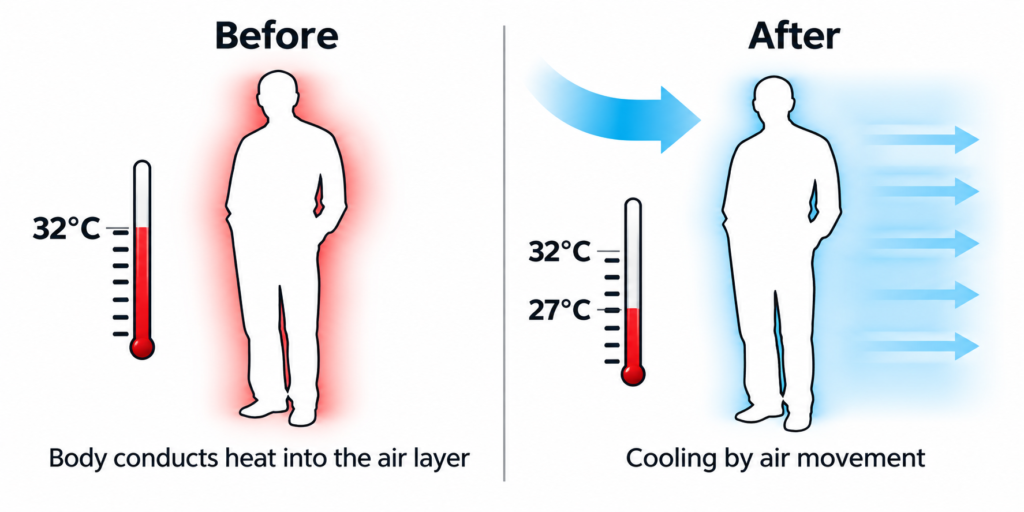
Thermal comfort is not determined by the thermometer alone. Air speed, humidity, radiant heat, clothing and activity can all affect how warm a person feels.
The supplied chart illustrates an example in which increased air movement changes the effective temperature experienced by a person even though the dry-bulb air temperature remains 32°C.
- Read the chart as an illustration, not a performance guarantee
- Actual results depend on humidity and local air speed
- Fan selection and commissioning affect the occupied-zone airflow
- Heat-stress risks still require a suitable workplace assessment

- FAQS
Frequently Asked Questions
Summer comfort in large buildings depends on more than the thermometer alone. Air speed, humidity, radiant heat, clothing, activity level, building height and the position of people within the airflow can all affect how warm conditions feel.
HVLS fans increase air movement across broad occupied areas to support convective and evaporative heat loss. They can improve perceived comfort, but they do not refrigerate the building or directly reduce dry-bulb air temperature like air conditioning.
These FAQs explain how MegaFan summer airflow works, how it can complement existing cooling and ventilation systems, and what should be considered when designing a system around the actual building.
Do HVLS Fans Lower The Actual Air Temperature?
No. HVLS fans move air rather than refrigerating it. Increased air movement can help people lose heat more effectively through convection and evaporation, so conditions can feel cooler even when the measured air temperature remains similar.
Why Does Moving Air Make People Feel Cooler?
Moving air replaces the warmer boundary layer of air next to the skin and can support both convective and evaporative heat loss. The effect depends on factors including air speed, humidity, clothing, physical activity and radiant heat.
How Much Cooler Can An HVLS Fan Make A Building Feel?
There is no single guaranteed figure that applies to every building. Perceived cooling depends on fan speed, installation height, humidity, work rate, clothing, radiant heat and where people are positioned within the airflow pattern. Any effective-temperature example should therefore be treated as an illustration rather than a guaranteed temperature reduction.
Can HVLS Fans Work With Air Conditioning?
Yes. A correctly designed HVLS system can help distribute conditioned air across a wider occupied area and reduce local hot and cold pockets. In some buildings this may allow the site to review cooling set-points, operating hours or HVAC strategy, but any energy or runtime reduction is building-specific and should be assessed against the actual system and controls.
Can HVLS Fans Replace Fresh-Air Ventilation?
No. A recirculation fan does not introduce fresh outside air or remove stale or contaminated air by itself. HVLS airflow can help distribute incoming air through a building, but it does not replace fresh-air supply, extraction, filtration or required local exhaust ventilation.
Will An HVLS Fan Create An Uncomfortable Draught?
It should not when the system is correctly selected and commissioned. HVLS fans are designed to provide broad air movement at relatively low rotational speeds, and variable-speed control allows airflow to be adjusted around occupancy, activity and comfort requirements. Fan position and final commissioning remain important.
What Information Is Needed For A Summer-Cooling Survey?
Useful information includes the building length, width and height, roof structure, occupied working zones, heat sources, machinery or process loads, large doors, existing ventilation or air conditioning, lighting, sprinklers, racking, electrical supply and photographs of the building. This allows the system to be designed around the real occupied areas rather than floor area alone.